Wednesday, 23 November 2016

In Depth Case Study - 28 Weeks Later

The Film.

Type- Feature 
Release Date- 26/4/07
Approx Running Time- 99m 53s
BBFC Insight- contains strong language and gore
Director- Juan Carlos Fresnadillo
Cast Includes- Rose Byrne, Jeremy Renner, Harold Perrineau, Catherine McCormack, Mackintosh Muggleton, Idris Elba, Imogen Poots

Synopsis.


During the original outbreak of the Rage Virus, Don , his wife Alice, and four other survivors hide in a barricaded cottage on the outskirts of London. They hear a terrified boy pounding at their door and let him in. A few minutes later, they discover that the infected have followed the boy to them. The infected attack and kill most of the survivors, while Don, Alice, and the boy are chased upstairs. Don pleads with Alice to abandon the boy, but she refuses. He abandons them as the infected break into their room by busting out of the window. Don desperately sprints to a nearby motorboat, narrowly escaping after a tussle with a recently turned survivor.NATO forces take control of Great Britain. Twenty-eight weeks after the outbreak, an American-led force, under the command of Brigadier General Stone, brings in settlers. Among the new arrivals are Don and Alice's children, Tammy and Andy, who were out of the country during the outbreak. They are admitted to District One, a safe zone on the Isle of Dogs guarded by the U.S. Army. Sergeant Doyle, a U.S. Delta Force Sniper and his friend, Chief Flynn, a helicopter pilot, are amongst the military presence in charge of guarding the district. Tammy and Andy are reunited with their father, who was found by the U.S. Army and has become the district's caretaker.

That night, Andy dreams about forgetting his mother's face, so Tammy and Andy sneak out of the safe zone, and return to their former home, where they begin to collect family photographs and other mementos. To his shock, Andy finds Alice alive and uninfected in a semi-conscious, delirious state. The three are soon discovered by soldiers and taken back to District One. Alice is taken to a quarantine room, where she is tested and found to be an asymptomatic carrier of the rage virus. Don makes an unauthorised visit to Alice in her isolation cell, begging her to forgive him. She accepts his apology and tells him she loves him.
General Stone orders the building to be quarantined and District One to be put into Code Red lockdown. Civilians are herded into safe rooms, but despite the precautions, a domino effect of rapid infection. The mob - now with half its members infected - breaks out of the safe room and into the streets. Scarlet , a U.S. Army medical officer, rescues Tammy and Andy as the soldiers in District One are ordered to shoot indiscriminately. Doyle, unable to bring himself to comply with the order, abandons his post and escapes with Scarlet, Tammy, Andy, and several others. General Stone orders District One to be firebombed, but large numbers of the infected, escape the bombardment. Scarlet informs Doyle that the children might hold the key to a cure and must be protected at all costs. Flynn arrives by helicopter to pick up Doyle, but he refuses to take anyone else, as they would be shot down for carrying people who are possibly infected.

Flynn contacts Doyle by radio and tells him to head to Wembley Stadium, but to leave the civilians. Doyle ignores his instructions and escorts Andy, Tammy and Scarlet to Wembley. They break into an abandoned Volvo V70 to escape nerve gas released to kill the infected, but are unable to drive away due to corpses jamming the wheels as soldiers intending to light the gas with flamethrowers draw near. Doyle exits the car and sacrifices himself by push starting the car and is subsequently roasted alive. Scarlet escapes an Apache gunship and drives Tammy and Andy into the London Underground, where the trio continues on foot. Don ambushes and kills Scarlet, then bites Andy. Tammy shoots Don before he can kill Andy, who remains symptom-free but an unknown carrier of the Rage virus. They continue to the stadium and are picked up by a reluctant Flynn, who flies them across the English Channel to France, as previously instructed by Doyle.


Gross Profit. 

Budget: 15,000,000


Theatrical Performance

Domestic Box Office
$28,638,916
International Box Office
$35,593,798
Worldwide Box Office
$64,232,714
Home Market Performance

Domestic DVD Sales
$24,681,478
Total Domestic Video Sales
$24,681,478

Production.


Both Fresnadillo and Lopez-Lavigne were involved in writing the script, which revolved around a family and what happened to them in the aftermath of the original film, which the producers "liked a lot". Boyle said in March 2005 that the sequel would feature a new cast, since previous cast members Cillian Murphy,Megan Burns, and Naomie Harris were occupied with their own projects. On 23 August 2006, Jeremy Renner was announced to portray Doyle, one of the principal characters for 28 Weeks Later. On 31 August 2006, Harold Perrineau was announced to portray a US Special Forces pilot in the film.On 1 September 2006, principal photography for 28 Weeks Later began in London with much of the filming taking place at Canary Wharf.

Marketing.


On 13 April 2007, 28 days before the release of the film in UK cinemas, a huge biohazard warning sign was projected against the White Cliffs of Dover. The sign contained the international biological hazard symbol, along with the admonition that Britain was "contaminated, keep out!" In July 2006, Fox Atomic Comics and publisher HarperCollins announced the publication, in early 2007, of 28 Days Later: The Aftermath, a graphic novel bridging the gap between 28 Days Later and 28 Weeks Later. Motion comics of two segments of the graphic novel were added to the DVD & Blu-ray release of 28 Weeks Later.

Removable chalk-powder graffiti was sprayed in locations around London and Birmingham featuring the web address www.ragevirus.com. However, the web address was found to be unregistered and was quickly snapped up. The advertising agency who made the mistake agreed to purchase the rights to the domain name for an undisclosed sum.

In April 2007, the horror/science-fiction film website Bloody Disgusting promoted 28 Weeks Later by giving readers a chance to win a prop from the film. The props were included in a "District 1 Welcome Pack", which featured an ID card and an edition of the London Evening Standard newspaper with a headline proclaiming the evacuation. The giveaway was only open to residents of North America, and entries closed on 9 May 2007.

In May 2007, 20th Century Fox posted a free 28 Weeks Later-themed flash game on their international website, foxinternational.com. In the game, the player can play one of the infected in three parts of the city.

Posters.


Friday, 18 November 2016

Ideologies And Beliefs Present

Ideologies.

One of the main ideologies I want to put forward in my trailer is family. The idea that despite what trauma we may have been through or no matter what the circumstances, I want it to be present that our mind will always roll back to the idea of family and a feeling of closure and comfort. This stems from The Family Systems Theory. A theory introduced by Dr. Murray Bowen that suggests that individuals cannot be understood in isolation from one another, but rather as a part of their family, as the family is an emotional unit. Families are systems of interconnected and interdependent individuals, none of whom can be understood in isolation from the system. This idea will be present as this will be why my character is alone, after the loss of his family he cannot connect with anyone and henceforth is by himself. This will also allow the reflective part of the trailer where i can include flashbacks.

Another is the prospect of revival. The idea that the efforts and endeavours of my main character can make a significant difference to either themselves or another, this will in turn help the mass and create a sense of revival. This promotes new beginnings and can link with my family ideology as revival can promote new beginnings and a new group to call family. The main effort of the main character is to do enough good to create a sense of revival where there will be a degree of tranquility and safety.


Beliefs.

A belief I want present is one of Gender Equality. Although my main character is a male, I aim to include a female role whom is independent and thriving in the environment. This helps show that women can be just as capable and strong in situations like this, this means I'm including women in the equation and therefore cannot be held accountable for leaving them out in my representation. This promotes equality and really pushes the belief that women are powerful and equal to men.

Equally the belief of Atheism and Secularisation will be very strong within the trailer. This will help the narrative as there can be philosophical questions asked that can reflect back on society as a whole. This will allow me to play on the resentment of religion due to tragedy and create a deeper slightly darker feel for the piece. As a key plot point it would work as a reflective narrative for the main film however I only want to touch briefly on it for the trailer.


Wednesday, 16 November 2016

Research Into Similar Products

Virus Genre

28 Weeks Later(2007)

Twenty eight weeks later.jpg28 Weeks Later is a 2007 British post-apocalyptic horror film, structured as a sequel to the critical and commercial success, 28 Days Later (2002). 28 Weeks Later was co-written and directed by Juan Carlos Fresnadillo, with Danny Boyle and Alex Garland, director and writer of 28 Days Later respectively, now acting as executive producers. It was released in the United Kingdom and United States on 11 May 2007. The on-location filming took place in London and 3 Mills Studios, although scenes intended to be shot at Wembley Stadium, then undergoing final stages of construction, were filmed instead in Wales, with Cardiff's Millennium Stadium used as a replacement.

World War Z(2013)


World War Z is a 2013 American science fiction apocalyptic action horror film directed by Marc Forster. The screenplay by Matthew Michael Carnahan, Drew Goddard, and Damon Lindelof is from a screen story by Carnahan and J. Michael Straczynski, based on the 2006 novel of the same name by Max Brooks. The film stars Brad Pitt as Gerry Lane, a former United Nations investigator who must travel the world to find a way to stop a zombie pandemic.
World War Z poster.jpgPitt's Plan B Entertainment secured the film rights in 2007, and Forster was approached to direct. In 2009, Carnahan was hired to rewrite the script. Filming began in July 2011 in Malta, on an estimated $125 million budget, before moving to Glasgow in August 2011 and Budapest in October 2011. Originally set for a December 2012 release, the production suffered some setbacks. In June 2012, the film's release date was pushed back, and the crew returned to Budapest for seven weeks of additional shooting. Damon Lindelof was hired to rewrite the third act, but did not have time to finish the script, and Drew Goddard was hired to rewrite it. The reshoots took place between September and October 2012.
World War Z premiered in London on June 2, 2013, and was chosen to open the 35th Moscow International Film Festival. The film premiered in New York, and Los Angeles on June 14, 2013, and released everywhere on June 21, 2013, in the United States, in 2D and RealD 3D. The film received positive reviews for Brad Pitt's performance and as a realistic revival of the zombie genre, but received certain criticism for the anti-climax and outdated CGI. Regardless, the film was a commercial success, grossing over $540 million against a production budget of $190 million, becoming the highest-grossing zombie film of all time. A sequel was announced shortly after the film's release and is scheduled for June 9, 2017.

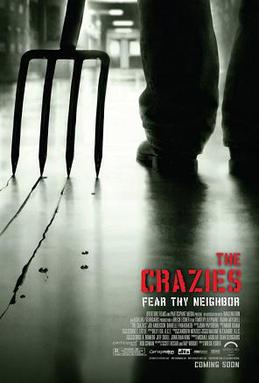
The Crazies(2010)

The Crazies is a 2010 American science fiction horror film directed by Breck Eisner, with a screenplay by Scott Kosar and Ray Wright. The film is a remake of the 1973 film of the same name by George A. Romero, who is an executive producer of the remake.
Crazies ver2.jpgThe Crazies stars Timothy Olyphant and Radha Mitchell. The film takes place in the fictional town of Ogden Marsh, Pierce County, Iowa, "friendliest place on Earth," whose town water supply is accidentally infected with the "Trixie" virus. After an incubation period of 48 hours, this virus gradually transforms the mental state of the infected into that of cold, calculating, depraved, bloodthirsty killers, who then prey on family and neighbors alike.
The film was released on February 26, 2010 to positive reviews from critics, and was a modest box office success.


Friday, 11 November 2016

The Genre

Main Genre.

My main genre for this piece is Post Apocolyptic Fiction. This genre draws on many sub genres and themes throughout it's presence in the media. For example shows such as The Last Ship and The Walking Dead. Equally there is a strong presence in film as well, films such as Snowpiercer, Dawn Of The Planet Of The Apes and also Dredd. These films all differ in narrative and sub-genre but still follow the main idea of a Post Apocolyptic Dystopia. 

This is an idea that I will continuously refer back to in my work. The idea of a world in shambles where the minority are in a stable status. The idea can exhibit theme's of Horror, Science fiction, Action and Thriller in as well to help progress the narrative. The variety of Post Apocalyptic Fiction I'm using is Virus, this simply means that the cause of the apocalyptic period is due to a virus.

Sub- Genre.

The Sub-Genre's I am going to use in my trailer are Action and Sci Fi. these aspects draw heavily on an immersive storyline. This will allow me to use props with more detail and a more futuristic vibe. As well as this I can focus more on the cause of the apocalypse and create and better back story. The action also benefits the trailer meaning I can use more immersive shots that follow a character through a firefight. Allowing the audience to get a small taste of what the film is about, whilst not giving away the full picture. Various films such as I Am Legend have used Action as a Sub-Genre this has proven effective in their product. 

Wednesday, 9 November 2016

Further Audience Research

Impact on Audience

The impact on my audience will stem from my ideologies. it will impact them in the way I intend so much so that they will rethink their everyday lives. We live in a arguably Capitalist society where we do almost everything to earn money which then benefit's those above us in class and economic hierarchy. My film is designed to make people rethink the way they live. Be it in a low income family or the biggest mansion on the South Coast.

My argument is that we do most things that benefit others without thinking. People fall in love to spend time but also to share living cost and utility costs. Sometimes people have children to not only have a family but to also receive the income support. The idea I put across is we are put here to help the economic gain of others and we live our lives unconsciously making choices that promote this. However the impact I want my audience to receive is "When there's no hierarchy or economy to conform to, what do you do".

When you finally have the freedom, when there's nothing left and everything's gone it's the things you didn't do that bother you. The flashbacks in my film are designed to help show this by using the idea of remorse and guilt. Showing that my main character wants more time with his loved ones and wishes he could change that.

It's designed in a way that I aim to make people less materialistic and more emotionally aware. By showing them that if something like this happens there will be nothing, they will then do everything to secure themselves with the love and care whilst they can. The idea that we need to make decisions that'll benefit us for a long time and showing we need reassurance and positivity in choices. That when trauma and disaster strikes we can then say these choices still help me now. So as well as the idea of love and family it's also trying to show the impact of investment in yourself and those around you.

By making the smart investments of only doing things you can sustain and not fear the loss of, you're able to stay functioning through these hardships. Therefore It could be argued that my film's main impact is to oppose structure and capitalism and do the things that benefit yourself to help prepare for the worst possible future. For example start a survival cache or perhaps learn survival skills that would help if you ever have to become totally self sufficient. In a world where we're reliant on others for even our basic needs my message is to always be prepared because where there's disaster and mass hysteria there's only one person you can only rely on and that's yourself.

Audience Effects Debate

As well as my main impact, I understand there will be subsidiary effects that will take a toll on my audience. As stated my film takes place in a period where society is merely a desecrated idea of what once existed, and therefore morality and deviance are two terms that will be brought into question considerably in the piece.

For example the trailer will feature scenes of violence that may no be appropriate for some audiences due to them being impressionable. This is part of the audience debate, it's not only what an audience can take away from a film. But just as importantly what a film can do to an audience, my main intention is do educate and make aware whilst promoting the love and preparedness I mention. However there are scenes I intend to use in my trailer that could be seen as warranting criminal behavior. 

What must be remembered is that my product doesn't take place in the contemporary society we currently have in the UK and even other countries like Russia, France and America. It takes place in a desolate period of disarray. Where there is no structure or enforcement and deviance runs high. The acts of merciless killing and theft in my film. Are not things I would promote to anyone in society today. These acts are subject to the environment and could be related to war torn areas such as Syria, Afghanistan, Somalia and Iraq. The heinous acts committed in these regions are judged by the west as terrible because of the society we live in where we are filled with morality and hope. 

However these countries suffer just like the location I use in my film does. The point I make is that environment warrants behavior to a degree and that just because someone has seen my product doesn't mean that they have reason to mimic the act's. The reason the individual in the film does what he does is due to the collapse in morality he has received due to the decline of society and the environment he has been left in. Nothing warrants these acts in modern day UK or other 1st world countries where we have a functioning society, law enforcement, infrastructure, medical care and other vital support. Likewise that doesn't meant it warrants these things in countries that don't have these things, however we must understand we cannot begin to think what that must be like and therefore cannot judge the actions made in these countries to help people survive.

Audience Theory

Audience segmentation is a process of dividing people into subgroups based upon defined criteria such as product usage, demographics, psychographics, communication behaviors and media use. Audience segmentation is used alot in commercial marketing so advertisers can design and tailor products and services that satisfy the targeted groups. This is a process which I have undertaken to ensure that my audience gets the most out of my product, and equally so I can get get the most back in profit and media coverage.

In social marketing, audiences are segmented into subgroups and assumed to have similar interests, needs and behavioral patterns and this assumption allows social marketers to design relevant health or social messages that influence the people to adopt recommended behaviors.This is how I chose my audience and found that there is a large audience that would be interested in my product.

Image result for maslow's hierarchy of needsEqually the film product itself can be related back to Abraham Maslow and his Hierarchy of Needs. This is as the idea of watching films stems from their physiological need to grow, the input the film has can change them emotionally as well as academically and is why watching moving image is so appealing to people as a pass time.

It can also provide a sense of false consciousness in the idea that you're engulfed in a film to the point where you forget everything and remain in a state of transcendence. It gives people the opportunity to forget the real world problems they face and gives them a brief sense of tranquility and it could be argued Self-Assimilation. This is one reason moving image has such a large following and audience before you introduce plot and genre.


Wednesday, 2 November 2016

Genre Theory

Plot and Genre


If I was asked to describe my plot in one sentance it would be:

A virus survivor scavenges for supplies and reminisces back to and past life moments.

However in the media there are 7 basic plots they are as follows:
7 Basic Plots.
  1. Overcoming of the monster
  2. Rags to riches
  3. The quest
  4. Voyage and return
  5. Comedy
  6. Tragedy
  7. Rebirth

The plot's in bold are the one's that I feel my concept can tie in with. As the trailer flows and in the movie itself if it were made, I would foresee the plot following these paths to reach the end of the product.

These come from a book called, The Seven Basic Plots: Why We Tell Stories. This is a 2004 book by Christopher Booker, a Jungian-influenced analysis of stories and their psychological meaning. Booker worked on the book for 34 years. Carl Jung was a Psychiatrist and was the founder of analytical psychology which focuses on the importance of the individual psyche and the personal quest for wholeness which can be related back to the idea of plot and narrative. Jung's school of thought helped to found Family Systems Theory, a psychological theory that I have used as an ideologies that will be interpreted into my trailer.

There are also several genre theories that producers, screenwriters and directors can follow when making their product these are:
  • Descriptive,
A descriptive view/approach relies heavily on paradigms. This is as when we see something such as a film we slot it into a paradigm, by looking at things like structure, theme or visual style. Categories also include: character archetypes, costume, setting, shot transitions and also plot
  • Functional,
A functional view/approach focus’ on patterns. The repetition of patterns are the repetition on social questions. The functional model reaches audience and meets their concerns, the questions are: What’s frightening, What is criminal/what are the boundaries of social morality